
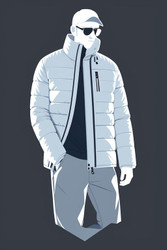
Born out of practical necessity rather than aesthetic ambition, the puffer jacket has one of the most remarkable origin stories in modern outerwear. Its beginnings stretch back to 1936, when American outdoorsman Eddie Bauer patented the first quilted, goose-down–insulated jacket. The invention was far from a casual experiment. Bauer had recently endured a near-fatal encounter with hypothermia while on a winter fishing trip, his standard wool jacket having become heavy, waterlogged and dangerously ineffective. Shaken by the experience, he set out to design something radically better; lightweight, insulating, and capable of retaining warmth even in brutal conditions. The result was the prototype of the puffer jacket, a garment that would eventually reshape both outdoor clothing and global fashion.
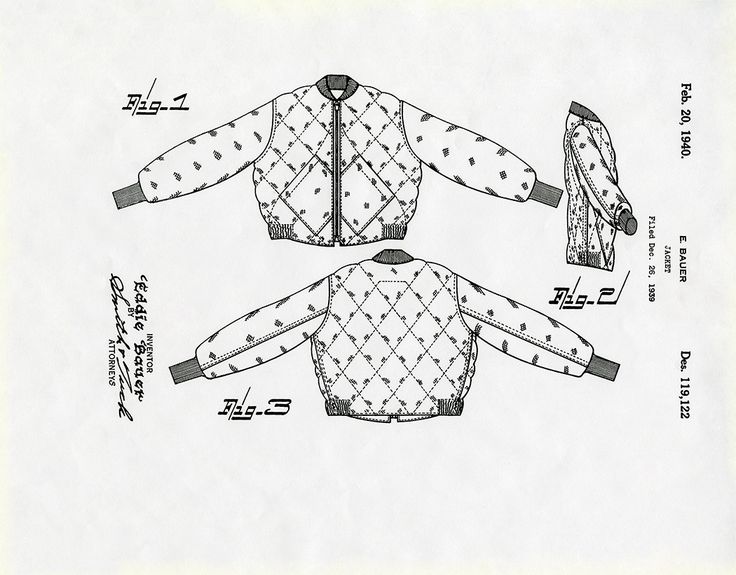
The Eddie Bauer jacket patent design.
From Practicality to the Pinnacle of Society
What makes the puffer jacket’s early years particularly intriguing is the speed with which it leapt from rugged outdoor gear to high-society curiosity. Just a year after Bauer’s initial design, English couturier Charles James unveiled a one-off evening jacket featuring cinched waists and sculptural, topper-style padding. Though strikingly impractical compared to Bauer’s utilitarian creation, James’s piece demonstrated the aesthetic possibilities of quilted insulation. It was so artistically significant that it earned a place in Victoria & Albert Museum, giving the humble puffer an unexpectedly glamorous early chapter.
Yet it was Bauer’s functional vision that captured the wider imagination. Outdoorsmen quickly recognised the advantages of a jacket that combined warmth, lightness and freedom of movement. As mountaineering, skiing and winter hiking surged in popularity through the mid-20th century, the puffer jacket became an essential companion on slopes and summits alike. Its fame during this period had little to do with street style; it was valued for its life-saving practicality in sub-zero environments.
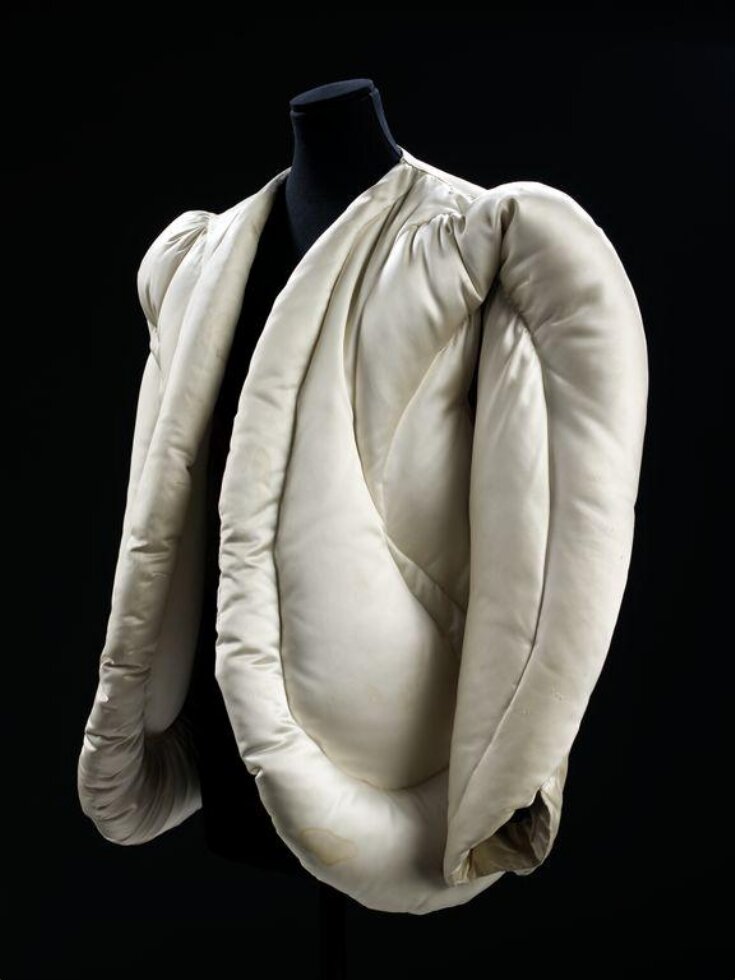
The Charles James design from the Victoria & Albert Museum collection.
The Sleeping Bag Coat: A Fashion Awakening
Although puffer jackets gained occasional visibility via celebrities holidaying at alpine resorts, high fashion largely overlooked them until the early 1970s. The turning point came in 1973 with the arrival of designer Norma Kamali’s now-iconic Sleeping Bag Coat. Much like Bauer decades earlier, Kamali’s breakthrough was inspired by an outdoor experience, albeit a far less perilous one. Caught short on a camping trip with no toilet facilities, she wrapped herself in her sleeping bag for warmth during a dash to the trees. Mid-stride, she realised that the cocooning comfort of a sleeping bag could translate into an extraordinary coat.
Back home, Kamali deconstructed her sleeping bag to create a pattern for what would become one of the most influential fashion garments of the decade. Voluminous, inviting and unashamedly warm, the Sleeping Bag Coat paved the way for the puffer jacket’s acceptance as a legitimate fashion item rather than merely alpine equipment. It signalled that insulation and elegance, comfort and couture, need not be mutually exclusive.
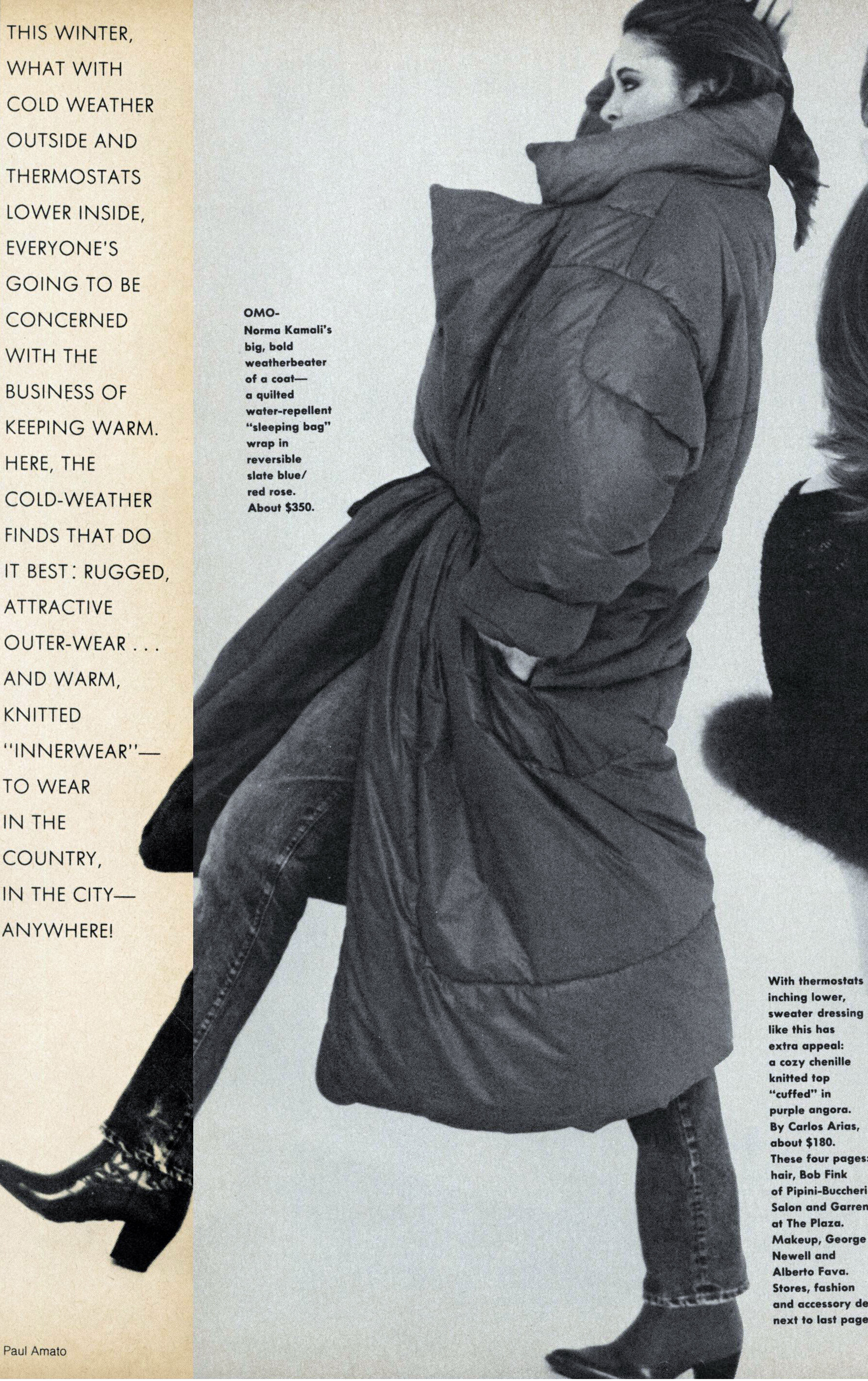
Advert for Norma Karmali's 1970s 'Sleeping Bag Coat'.
Subcultures, Status and the 1980s Boom
As the puffer jacket moved into mainstream visibility, it began to weave itself into the fabric of nightlife, youth culture and subcultural identity. In late-1970s New York, the jacket found an unexpected supporter in Steve Rubell, the co-founder of the legendary nightclub Studio 54. Rubell reportedly recognised that the jacket’s quilted structure offered ample hiding spots for illicit substances, a messy but memorable footnote in the puffer’s cultural evolution. Soon, puffers became a common sight on Manhattan dance floors, valued for both their practicality in harsh winters and their subversive potential.
Elsewhere, European youth cultures put their own stamps on the padded jacket. In Milan during the 1980s, the Paninari; a subculture obsessed with consumerism, fast food and high-end labels, championed the short, brightly coloured puffer jackets from brands such as Moncler. For Paninari, the puffer jacket was a badge of luxury and lifestyle aspiration.
Across the Channel, the UK's 80s Casuals often gravitated towards designs from Stone Island, incorporating the brand’s technical textiles and military-inspired aesthetic into terrace culture. With prices far beyond the average football fan’s means, these jackets became symbols of status, swagger and style, though perhaps not the most practical choice for anyone hoping to avoid police attention before kick-off.
Streetwear, Sportswear and the 90s Resurgence
As the 1980s gave way to the 1990s, the puffer jacket continued its migration from mountain slopes to urban streets. Sportswear brands such as Fila Vintage and Ellesse embraced the trend wholeheartedly, infusing puffers with bold colour-blocking, stripes and oversized silhouettes. This iteration of the jacket fit perfectly within the burgeoning hip-hop scene, where large insulated jackets became synonymous with street identity, musical expression and winter-ready swagger.
By the century’s end, the puffer had also cemented its place on high fashion runways. Designers like Alexander McQueen reinterpreted the garment with avant-garde flair, famously introducing duvet-style coats that blurred the line between bedding and outerwear. The once-humble down jacket had become a muse for some of the world’s most imaginative fashion minds.
The 21st Century: Ubiquity with Purpose
In the 21st century, the puffer jacket shows no sign of relinquishing its dual roles as functional winter armour and fashion must-have. Brands such as Balenciaga have continued to push the limits of silhouette, scale and exaggeration, transforming the puffer into runway sculpture. At the same time, its streetwear credibility remains fully intact. From city commuters bracing chilly mornings to outdoor enthusiasts heading for frosty trails, the puffer jacket remains the quintessential cold-weather companion.
The reasons for its longevity are clear: the combination of water-resistant shells, down or synthetic insulation and modern technical fabrics provides exceptional warmth and reliability. No matter how bold the colours or experimental the shapes become, the core promise of comfort and protection remains unchanged—a testament to Eddie Bauer’s original vision nearly a century ago.
Puffer Jackets at Atom Retro
At Atom Retro, we celebrate every side of the puffer jacket’s rich heritage. From 70s-inspired ski silhouettes to 80s terrace-ready designs, our quilted coats channel iconic eras while embracing modern comfort. With standout styles from Fila Vintage, Luke 1977, Madcap England, French Connection and Ellesse, there’s a puffer for every taste—sporty, retro, classic or contemporary.
Explore our full puffer jacket collection and discover a winter essential with nearly 100 years of history stitched into every quilted panel.
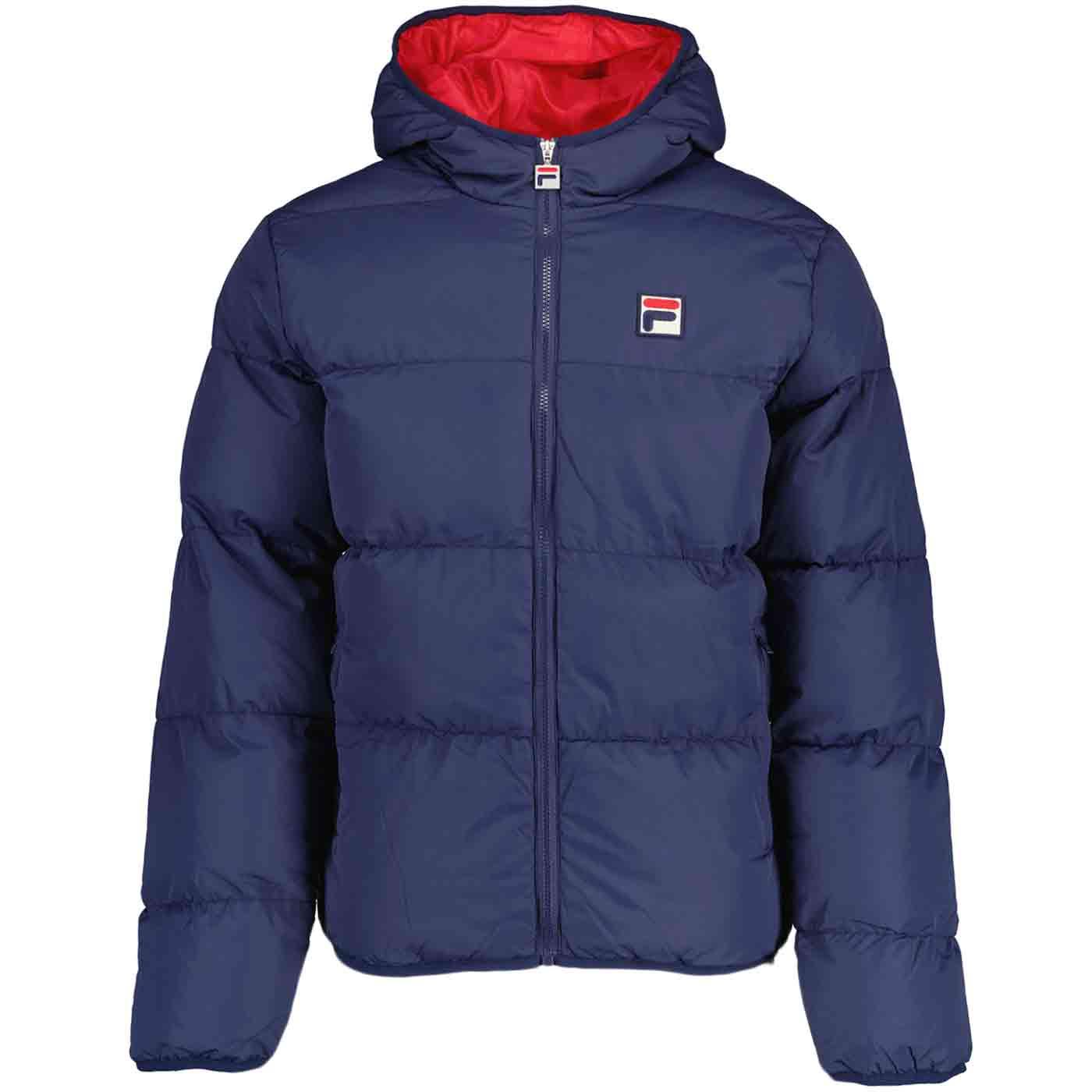
The Fila Vintage 'Harry' Heavily Padded Puffer Jacket.